


:quality(75))
:quality(75))
In this episode of Rethinking Leadership, Roemer Visser speaks with Christopher O.H. Williams, former Fortune 500 executive, advisor, speaker, and author of C.O.U.R.A.G.E.: Seven Choices for Living a Life Without Regret. Williams held senior roles at Nike, Adidas, and VF Corporation, after earlier working at Gap, Goldman Sachs, and Lehman Brothers. By most conventional standards, he had built an exceptionally successful career. And yet, in 2018, he stepped away from the corporate world.
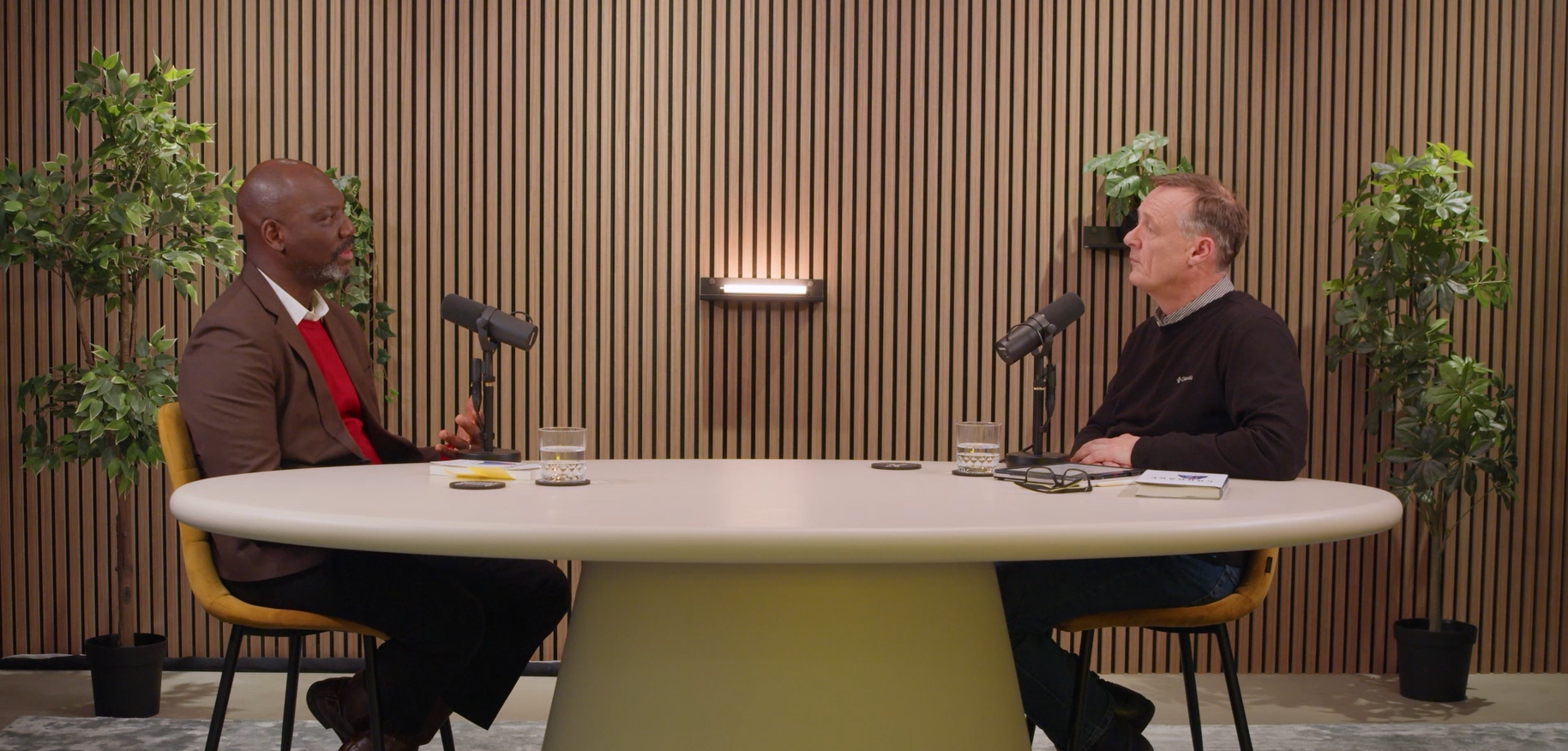
That decision becomes the starting point for a thoughtful and personal conversation between Roemer and Christopher about success, freedom, purpose, and courage. Roemer looks beyond the career change itself and explores the deeper questions behind it: what does it take to stop following a path that has rewarded you, defined you, and shaped how others see you?
When success no longer feels like enough
Christopher describes his 2018 decision not as a sudden rejection of corporate life, but as the result of a growing disconnection. He was successful, close to the top, and still moving upward. But the work no longer felt fully aligned with what mattered to him.
He describes that moment as one in which he had to ask himself what his legacy would be, how he could use his talents, and what kind of impact he wanted to have. A health emergency involving someone on his team sharpened that reflection. It reminded him how fragile life is, and how easily people can become consumed by work without asking what the work is ultimately for.
As Christopher puts it: “What is the purpose of doing the work that we do and the way that we do it very intensively, completely consumed by it, if it’s not to build something bigger than us?”
That question becomes one of the central threads of the episode. Roemer picks it up and connects it to leadership more broadly. If leadership is only about performance, bonuses, growth, or promotion, then courage can easily become courage in service of a very narrow goal. The deeper question is: what is your courage working for?
The hidden trap of success
Roemer highlights a familiar paradox that many people pursue success because they believe it will create freedom. But that in the process, they often get locked in.
Christopher agrees: As careers grow, people often build lifestyles, relationships, identities, and expectations around that success. What once promised freedom can become a structure that limits movement.
Christopher says: “It’s not what we need to survive. It’s what we’ve told ourselves we need.” For him, this is why people need to remain in conversation with themselves. What do I need? What do I want? What do I have? And are these things still in balance?
Courage means acting despite fear
Roemer then brings the conversation back to the word at the heart of Christopher’s work: courage. Is that what allowed him to face the questions others might postpone?
Christopher’s answer is clear: courage.
That definition keeps the conversation grounded. Courage is not fearlessness. It is the ability to act when fear, uncertainty, and risk are present. For Christopher, leaving corporate life meant giving up more than a job. It meant stepping away from a long-term aspiration, a familiar identity, and, in some ways, an old tribe.
That shift required more than one decision. As Christopher says, “Sometimes you have to make some of those choices as well, because you have to be systemically true to yourself.”
Purpose gives courage direction
In Christopher’s book, C.O.U.R.A.G.E. is an acronym. The first letter stands for “commit to your purpose.” Roemer asks why that comes first.
Christopher explains that courage needs something to work for. Without a deeper commitment, courage has no direction. His line is simple and powerful: “It’s hard to be courageous about anything if you don’t care much about anything.”
This is where the conversation moves from personal transition to leadership. Many leadership conversations remain transactional: how do we get more performance, more output, more results? Roemer challenges that frame. Christopher builds on it by arguing that leaders and organizations often claim ambitious purposes, but in practice return quickly to targets, quarterly results, and incentives.
For Christopher, real leadership requires a stronger connection between stated purpose and actual choices. Companies have influence, reach, and power. They can do well and do good. But that requires leaders who are willing to have harder conversations in boardrooms, with peers, and with shareholders.
Start by listening
Toward the end of the episode, Roemer asks what people should do if they do not know their purpose yet. Christopher resists making the answer too grand. Purpose does not always begin with a perfect mission statement. It can begin with attention.
What bothers you? What moves you? What creates dissonance between what a system says and what it actually does?
His advice is to “listen to yourself and listen to the world around you.” Purpose, in that sense, is not something you invent from scratch. It is often something you discover by paying closer attention to where your empathy, frustration, and energy already go.
Taken together, the episode is not simply about leaving corporate life. It is about examining the structures we build around success, and asking whether they still serve who we want to become. Roemer and Christopher’s dialogue invites leaders to start somewhere deeper than effectiveness: with purpose, meaning, and the courage to build something bigger than themselves.