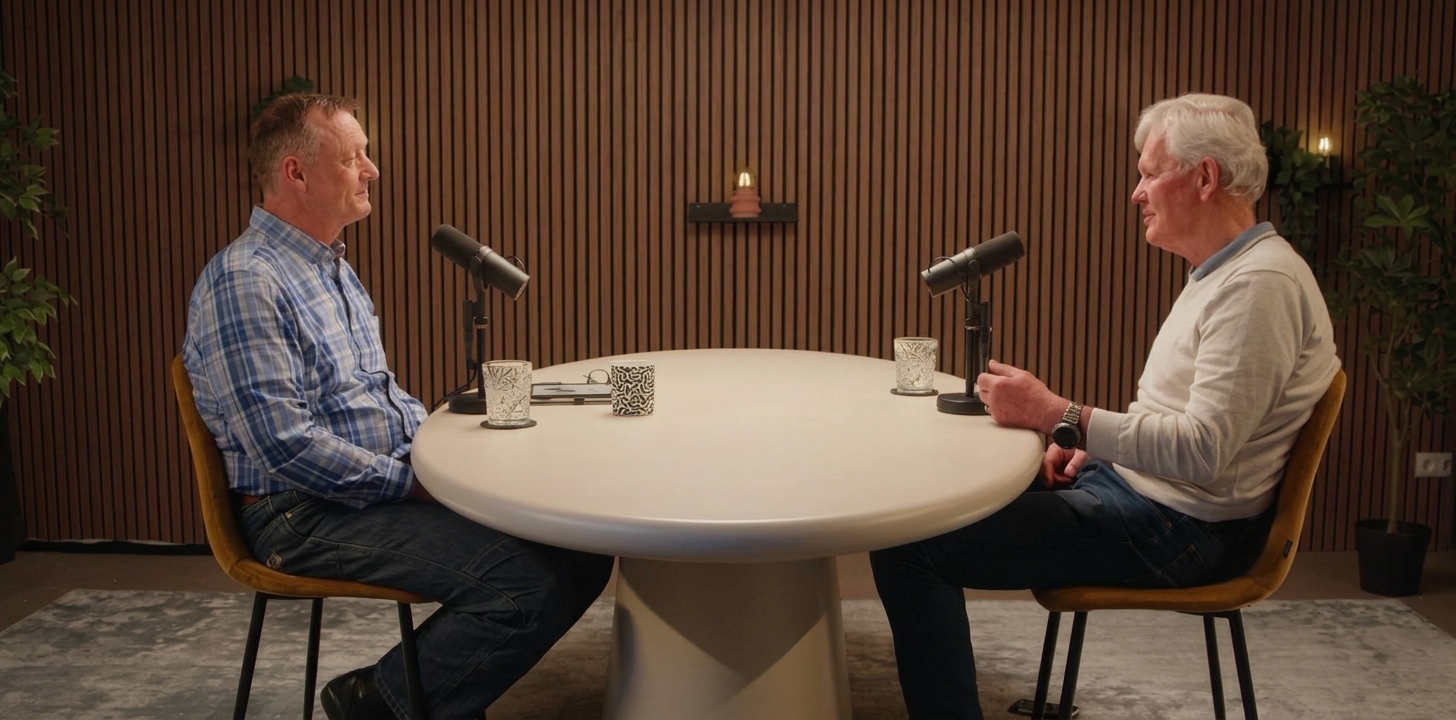
Their conversation explores what happens when personal ambition conflicts with collective success, why the strongest teams do not necessarily consist of like-minded people, and how leadership needs to change when circumstances become unpredictable.
When the mission matters more than the leader
Roy's most important leadership lesson begins with a personal decision. When he helped establish Team ABN AMRO's Volvo Ocean Race campaign, his ambition was to skipper the winning boat. But as the campaign took shape, he realized that positioning himself as a potential replacement for the selected skipper could undermine the very team he was trying to build.
He decided to remain in his leadership role on shore rather than compete for a place on board. Roemer recognizes the significance of that decision: the mission has to come first, even when it means setting aside personal ambition. Roy agrees: "The mission is first, the purpose is first, and I think that's the total focus. If you have your goal, that's what you want to achieve in a fair way, and you have to give people the chance. You have to help them instead of replacing them."
The lesson extends well beyond sailing. Leaders may be personally invested in a particular role, decision, or outcome. But when individual ambition begins to compete with the collective objective, it can weaken the very performance they are responsible for delivering. For Roy, leadership means recognizing when your greatest contribution is to enable someone else to succeed.
 The wisdom of the collective
That philosophy also shaped how Roy built his team. Rather than following sailing's traditional approach, in which the skipper selects the crew, Team ABN AMRO adopted a collective selection process. Roy selected the skipper. Together, they selected the navigator. Those three then selected another crew member, gradually building a team that had a shared responsibility for its composition.
The approach also challenged the assumption that successful teams need people who naturally get along. He deliberately included an experienced sailor whose individualistic approach differed from the team's preferred way of working. Roemer questions whether that kind of difference could become destructive under pressure. Roy acknowledges the challenge but explains that working through those differences strengthened the team. Different perspectives helped them see problems from new angles and develop greater confidence in their collective abilities.
The underlying principle is that high-performing teams need more than individual excellence. They need people who are willing to contribute their expertise to a shared purpose.
Who leads when everything changes?
Roemer then challenges him on a familiar argument for hierarchical leadership: surely, in a crisis, someone needs to take command? Roy offers a more nuanced perspective, distinguishing between three environments: predictable conditions, difficult but foreseeable situations such as storms, and completely unexpected events.
In stable conditions, traditional hierarchy can work well. In a storm, however, relying on one exhausted decision-maker becomes risky. Teams need to draw on their collective experience, prepare scenarios, and anticipate what might happen next. In truly unexpected situations, leadership may need to shift entirely.
Roy recalls moments in competitive sailing when someone other than the skipper unexpectedly stepped forward and took control. The skipper's responsibility was not to reclaim authority, but to recognize that another person was better equipped to lead at that moment. This raises a fundamental question for organizations: are people encouraged to step forward when their expertise is needed, or does hierarchy prevent them from doing so?
For Roy effective leadership is not necessarily tied to a fixed position. It can move between individuals depending on the situation, provided the team has developed the trust to make that possible.
Creating the conditions for others to perform
Later in the conversation, Roemer returns to a deceptively simple question: what is a skipper's most important responsibility? If the crew can still sail the boat without the skipper, what does the skipper actually contribute? Roys answer shifts the focus from directing performance to enabling it:
"The role of the skipper is to create the environment for people to do the best they can. So it's a lot more about looking after the people. But if you accept that there's a lot of wisdom on the boat, if you've selected the right team, then you don't have to have it all yourself. You can share that load with everybody. So in the end, it's the boat that wins."
Roemer pushes the argument further. Creating an environment in which everyone can perform sounds straightforward, but what happens when results deteriorate and the leader is still held accountable? Isn't the temptation to take back control overwhelming? Roy acknowledges that this approach is far from easy. It requires leaders to understand what motivates people, give them autonomy, listen to their ideas, and allow them to learn from mistakes.
It also requires knowing when to protect people from pushing themselves too far. On an ocean racing boat, where fatigue can have serious consequences, taking care of the crew is not separate from achieving results. It is essential to them.
From being a better leader to building a better team
Toward the end of their conversation, Roy challenges leaders to reconsider how they approach collaboration. Organizations often fall back on familiar structures because they feel safe, even when those structures prevent them from using the full potential of their people. He encourages leaders to question those habits and consider whether becoming a better leader might sometimes mean becoming a better coach.
The conversation ultimately returns to the lesson behind Roy’s decision to stay off the boat. Leadership is not about proving your own importance or always being the person making the decisions. It is about understanding what the team needs to achieve its mission and having the confidence to let others contribute.
The challenge for leaders is not simply to steer the boat, but to build a team capable of sailing it together.