


:quality(75))
:quality(75))
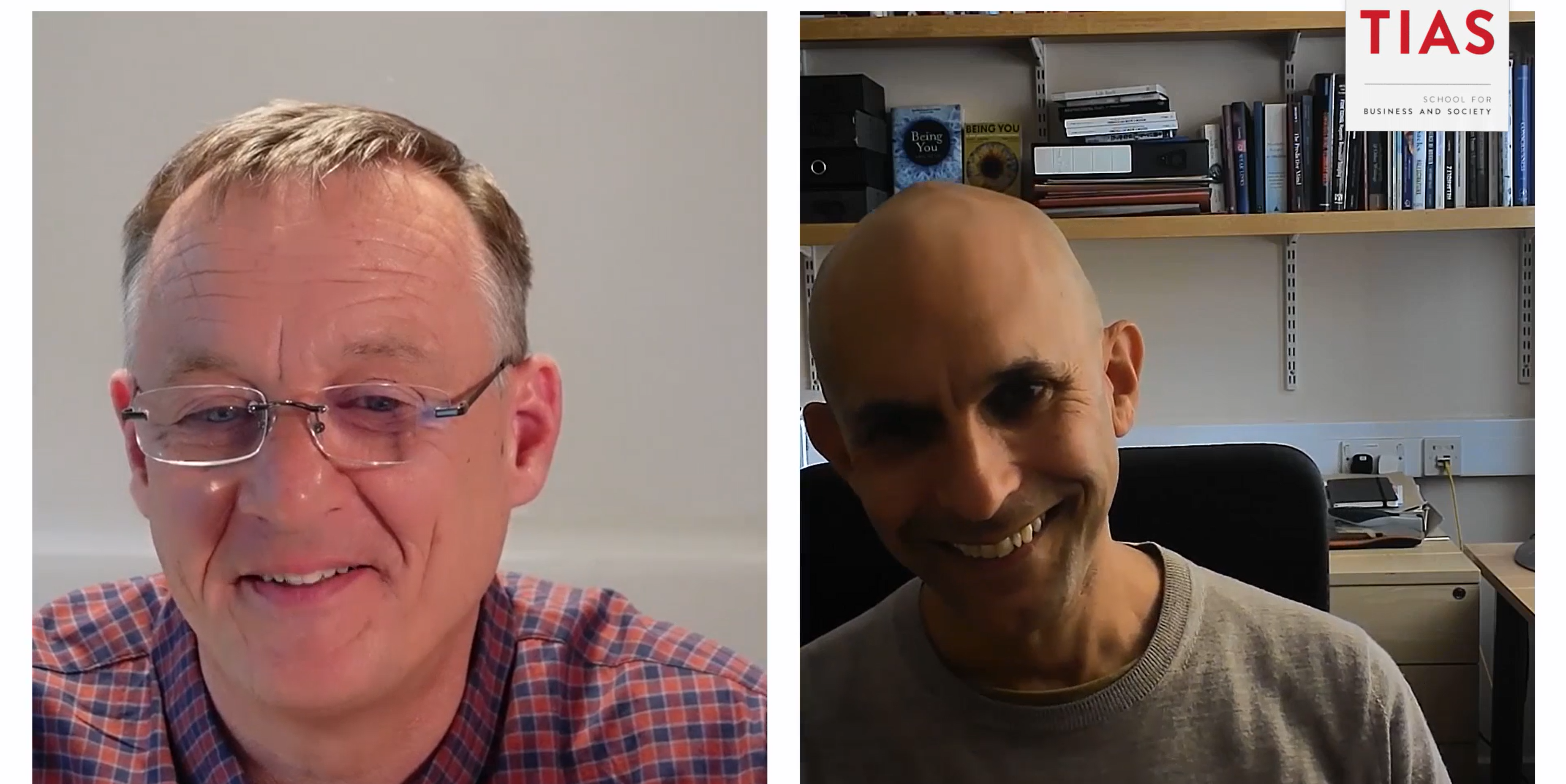
In this episode of Rethinking Leadership, Roemer Visser speaks with Anil Seth, professor of neuroscience and one of today’s leading thinkers on consciousness. Known for his TED Talk Your brain hallucinates your conscious reality, Seth brings a neuroscientific perspective to a question that quietly determines leadership success: why do leaders with similar intelligence, experience, and intent achieve very different outcomes?
Their conversation suggests a counterintuitive answer. Leadership effectiveness often does not break down at the level of strategy, competence, or effort, but at a deeper and largely invisible level: perception. How situations show up for a leader shapes decisions, relationships, and behavior long before any conscious choice is made.
Perception as a controlled hallucination
Seth’s starting point challenges a deeply held assumption. What we experience, he explains, is not a direct readout of the world. Perception is an active process in which the brain continuously predicts what is happening and updates those predictions using sensory data. He calls this a “controlled hallucination”.
The control is crucial. Our perceptions are not random or fictional. Evolution has trained our brains to stay closely coupled to reality. Yet experience itself is constructed from the inside out. Two people can be in the same meeting, hear the same words, and leave with entirely different understandings of what just happened.
For leadership, this insight is foundational. Success and failure often hinge not on what objectively occurred, but on how leaders interpreted the situation and acted from that interpretation.
Bias and perceptual habits
Bias, in Seth’s account, is not a flaw to eliminate but a feature of perception itself. The brain must rely on prior beliefs and expectations to make sense of incomplete and noisy information. These priors function as shortcuts that usually help us act quickly and effectively.
Over time, these shortcuts become perceptual habits: stable ways of seeing situations, people, and risks. The challenge is that these habits are largely invisible to us. As Seth puts it, “We see with them, we don’t know that we have them.”
In leadership contexts, perceptual habits quietly shape what feels urgent, threatening, or promising. They influence who is trusted, which signals are amplified, and which are ignored. When leaders get stuck, it is often because these habits no longer fit the reality they are facing, even though they still feel right from the inside.
From changing behavior to changing experience
Most leadership development focuses on behavior: what to say differently, how to respond more effectively, how to influence others. Seth does not dismiss this, but he points to a deeper leverage point. Because perception and action are inseparable, sustainable behavioral change often depends on changing how situations are experienced.
“If we experience the world and the self differently,” he notes, “then behavior can change very naturally as a result.”
This reframes leadership growth. Instead of forcing new behaviors onto old interpretations, leaders can learn to notice perception as it is happening. Seth describes this as “catching yourself in the act of perceiving”. By recognizing thoughts, emotions, and bodily reactions as experiences rather than facts, leaders create a pause between stimulus and response.
That pause is not abstract or philosophical. It is where better decisions, calmer conversations, and more adaptive leadership become possible.
Expectations, memory, and room to maneuvre
A hopeful thread in the conversation concerns expectations and memory. While past experiences strongly shape perception, Seth emphasizes that memory itself is not fixed. Each act of remembering is also an act of reconstruction. Over time, memories can drift and change.
This matters for leadership success because expectations operate in real time. What a leader anticipates shapes what they notice and how they interpret events as they unfold. By working consciously with expectations, leaders can expand the range of possible interpretations, even in familiar or tense situations.
Seth illustrates this with classic experiments showing that the same bodily signals can be interpreted as fear or excitement depending on context. Perception, emotion, and action form a continuous feedback loop. Changing the loop at the level of interpretation can change the outcome.
No monopoly on truth
One of the most practical leadership lessons in the episode is also one of the most challenging: nobody has a monopoly on the truth. Perception is neither fully objective nor arbitrary. There is a real world that constrains experience, but there are also multiple valid ways of experiencing the same situation.
Roemer and Anil discuss the famous image of the dress that some people saw as blue and black while others saw white and gold. The example makes their point tangible: even when people are clearly looking at the same thing, their experience of it can differ profoundly. Without much at stake, the illusion shows how perception feels self-evident from the inside, and how easily we assume our own view is the correct one.
Leadership as perceptual work
Seen through Seth’s lens, leadership success depends not only on vision, execution, or influence, but on perception. On noticing assumptions, expectations, and habits of seeing that shape every interaction.
Action still matters. But leaders who look beyond behavior to how situations are perceived tend to act with greater flexibility and effectiveness.