

:quality(75))
:quality(75))
Subtle workplace exclusion is often difficult to recognize. A colleague is not included in informal conversations, receives little response to ideas, or is repeatedly left out of important moments. Because these situations are ambiguous, employees often first doubt their own interpretation.
The straw that broke the camel’s back
In the publication The straw that broke the camel’s back: How attributions and a mental tipping point shape lived reactions to subtle workplace exclusion, Jamie Breukel, Sanne Nijs, Hans van Dijk, Marloes van Engen, Marijn Krol, and Stefanie Duijndam examine how employees experience subtle exclusion and how their reactions change over time. The publication appeared in Academy of Management Discoveries.
The researchers are affiliated with Tilburg University, TIAS School for Business and Society, and Radboud University. Hans van Dijk is Full Professor in Leading Inclusion at TIAS and conducts research on diversity, inclusion, and social inequality in the workplace and society.
From doubt to tipping point
The researchers interviewed employees about their personal experiences with subtle exclusion at work. The interviews show that employees are often not immediately sure what is happening. They wonder whether they are interpreting the situation correctly, whether they have done something wrong themselves, or whether others’ behavior is intentional or unintentional.
The researchers call this uncertainty attributional ambiguity: a lack of clarity about the cause of what someone is experiencing. In this phase, employees often first try to repair the relationship. They seek more contact, adapt their behavior, or try even harder to belong.
When these efforts do not work or become too draining, their response may change. Employees may withdraw, take less initiative, or become more silent within the organization. Eventually, a mental tipping point may occur: the moment when doubt disappears and someone starts to see the exclusion as a clear pattern.
The SWEAR model
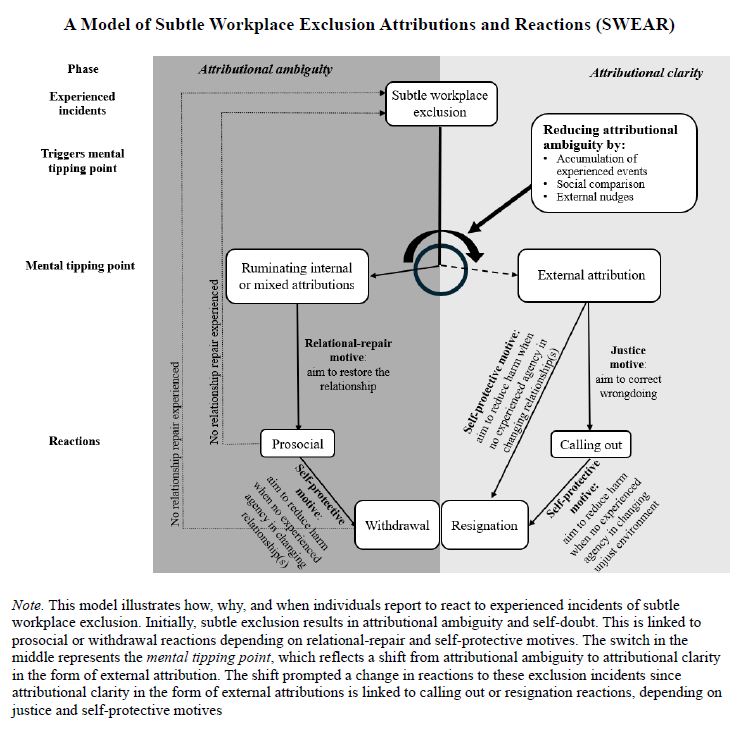
Based on the interviews, the researchers developed the Subtle Workplace Exclusion Attribution and Reaction model, or SWEAR model. This model shows how interpretations of and reactions to subtle exclusion can develop over time.
The model describes a shift from attributional ambiguity to attributional clarity. Once employees more clearly see that the cause of the exclusion lies outside themselves, their response often changes as well. Some employees speak up to restore justice. Others see no room or effect in doing so and instead distance themselves further.
According to the study, three triggers can contribute to this tipping point: an accumulation of exclusion incidents, comparison with how others are treated, and external signals, for example from a colleague, manager, confidential advisor, or external source.