


:quality(75))
:quality(75))
In this episode of Rethinking Leadership, Roemer Visser speaks with Jill Bolte Taylor, neuroanatomist, speaker and author, best known for her book Whole Brain Living and her viral TED Talk, to explore what her neuroscientific model means for leadership today. Their conversation moves beyond theory into a lively examination of how leaders think, react, and relate, and how they can learn to recognize the different “characters” inside their own brain.
From one brain to four characters
Most leaders, Taylor explains, operate predominantly from the left hemisphere, especially from what she calls Character 1, the structured, task-driven operator. In her own case, she has named this character “Helen,” short for Hell on Wheels because she ‘gets the job done’. When this mode takes over exclusively, leaders lose access to creativity, empathy, and innovation, capacities essential in today’s complex world. As they conclude it clearly: “The left brain is a fantastic servant, but a terrible master.”
Taylor encourages us all to move from Character 1 dominance to what she calls Whole Brain Living, which is about “recognizing the value of all parts of yourself so that you can, mindfully and enthusiastically, embrace all these different parts of who you are, so you can live a more peaceful life, be more productive, be more creative, and be more functional.”
Broadening the leadership repertoire means nurturing four internal characters:
Character 1 (left-brain, thinking): structured, focused, and task-oriented
Character 2 (left-brain, feeling): protective, cautious, and sensitive to threat
Character 3 (right-brain, feeling): creative, curious, and joyful
Character 4 (right-brain, thinking): connected, compassionate, and grounded
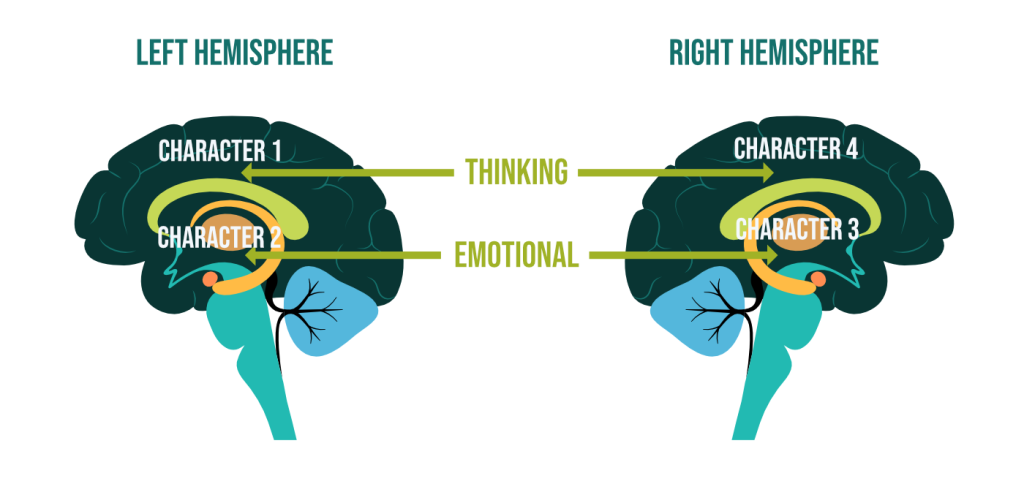
She and Roemer explore how recognizing these four modes gives leaders language for understanding their own inner landscape.
Genius lives in the right hemisphere
One of Taylor’s most striking assertions is: “Genius is in the right hemisphere.”
Character 3 fuels curiosity and experimentation, while Character 4 provides compassion, connection, and perspective. These capacities help leaders see possibilities beyond linear logic and form the relational foundation that leadership depends on. Yet many leaders overlook these modes because Character 1 becomes the dominant driver. The encouraging insight, Taylor notes, is that this dominance is learned and therefore can be unlearned.
Awareness creates choice
As their conversation unfolds, Taylor emphasizes that most people move through the world unaware of which character is running the show. Leadership, she argues, begins with learning to witness your own brain in action. Roemer reflects on how often leaders default to familiar patterns without noticing it, to which Taylor adds: “We have so much more power over what’s going on inside our brains than we’ve ever been trained to believe.”
Once leaders can identify their characters in real time, they gain the freedom to pause, breathe, and consciously shift into the mode that best fits the moment. This awareness becomes especially important in relationships. As Taylor notes: “If there are four characters inside of me, and four inside each person I lead, then for every two of us there are eight of us in the room.”
Leadership becomes relational not just between people, but between the multiple “selves” each person brings.
The opportunity in whole-brain leadership
Whole-brain leadership challenges traditional assumptions. It recognizes that structure and discipline are essential but insufficient. It makes space for emotional intelligence, creativity, and the role of fear and vulnerability. Rather than suppressing or ignoring parts of ourselves, Taylor calls leaders to integrate them.
This integration strengthens decision-making, unlocks creativity, deepens relationships, and builds resilience. And perhaps most importantly, leaders who understand their own internal team become far more skilled at navigating the internal teams of those they lead.