


:quality(75))
:quality(75))
How can our team engage in effective and efficient decision-making? TIAS professor of Strategic Leadership Ron Meyer presents an insightful tool to kickstart your thinking: Quadruple Diamond Decision-Making.
Key Definitions
Decision-making is the reasoning process whereby a person or group of people arrive at a particular choice. It is more than only decision-taking, which is the selection of one alternative out of several options. Decision-making also encompasses the prior steps of defining the issue for which a decision is needed and generating the options from which to select a decision.
Decision-making is effective if a solution is found to the problem identified (decision suitability), the solution can likely be put into practice (decision feasibility) and the solution is supported by enough stakeholders (decision acceptability). Decision-making is efficient if the process doesn’t take too much time, energy and resources of too many people.
Conceptual Model
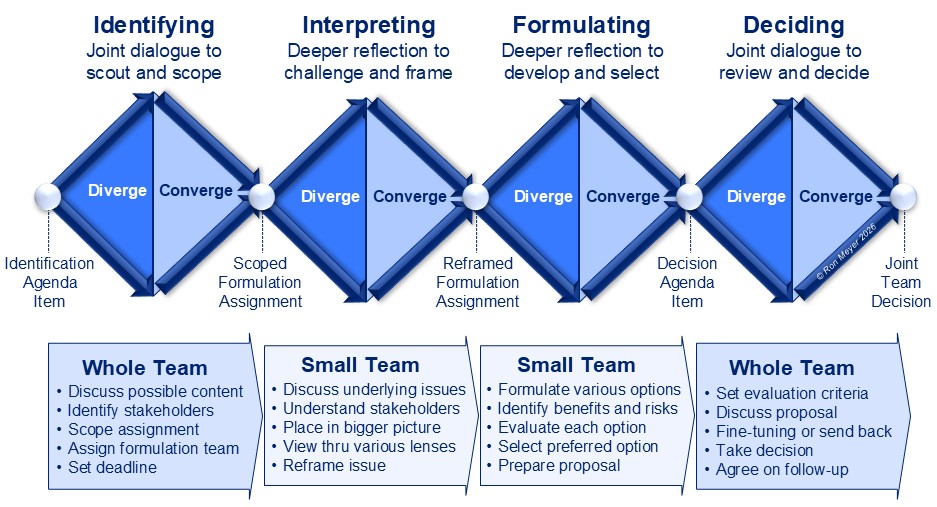
The Quadruple Diamond Decision-Making model suggests a decision-making process for teams that combines effectiveness and efficiency. It is an extension of the well-known Double Diamond model, launched by the British Design Council in 2005. This initial framework introduced the two middle diamonds – the first focused on interpreting a problem and the second on formulating a solution – both using the same approach of first diverging to scout for alternatives before then converging on a specific outcome. The Quadruple Diamond model adds two extra diamonds to turn this problem-solving approach into a full decision-making approach. At the beginning, it adds a diamond aimed at identifying which problem to focus on, while also adding a diamond at the end, aimed at jointly deciding on a proposed solution as whole team. Although this model introduces two extra steps to expand problem-solving into decision-making, it still improves efficiency by not involving the entire team in each step.
Key Elements
The four steps in the team decision-making process are the following:
1. Identifying: Scout & Scope. The first step is to determine which potential issues require decision-making at all. In this approach, any team member can put a topic they think is important on the meeting agenda (an “identification agenda item”). If after reviewing this issue from different perspectives during the meeting (divergence), it is deemed important enough for further consideration, the team should turn to scoping an assignment (convergence) for a group of 2 or 3 people to formulate a preferred solution and to present this proposal to the whole team as “decision agenda item” within a fixed period of time.
2. Interpreting: Challenge & Frame. The second step is for the small team to rethink the initial problem definition in their assignment, as the whole team usually doesn’t have the time to delve that deeply. This process of reframing also starts with divergence, by zooming in to the underlying issues and zooming out to see the bigger picture, while simultaneously trying to understand how different stakeholders view the topic. After exploring the issue from multiple perspectives and challenging the initial interpretation, the team then needs to converge on a richer, reframed formulation assignment.
3. Formulating: Develop & Select. The third step is for the small team to come up with the best possible solution, which often is not the most obvious one. To spark creativity and avoid the trap of following existing recipes, the small team again needs to diverge, generating a range of potential solutions, each with their own mix of benefits, costs and risks. Only once multiple options have been formulated should the small team switch to converging, by evaluating and comparing the various alternatives, and then selecting the most appealing one for presentation as decision agenda item to the whole team.
4. Deciding: Review & Decide. The fourth step is to get the buy in of the whole team. Again, this starts with divergence, reviewing the small team’s proposal from different perspectives and using various evaluation criteria to test its robustness. During this discussion, minor elements can be fine-tuned on the spot, but if larger questions arise, the team can “decide not to decide” and send the proposal back for further development. However, if the team feels comfortable with the proposal, they can converge on a formal joint decision, including agreement on the who, when and how of the required follow-up.
Key Insights
· Team decision-making should be done in four steps. For simple issues, teams can take the quick and dirty approach of “jumping to solutions”, but for more important issues teams should go through four steps: first identifying which issue requires decision-making, then interpreting the issue, formulating various options and finally deciding what to do.
· Team decision-making should switch between divergence and convergence. To avoid getting stuck in one way of thinking, in each step the decision-makers need to first generate alternatives (divergence) before selecting the best fitting one (convergence).
· Team decision-making should switch between whole and small team work. To save time and energy, the middle two steps should be carried out in a small team (2-3 people). To ensure buy in from the whole team, the first and last steps need to be done jointly.
· Team decision-making meetings should have identification and decision items. To save time, the agenda of the whole team should only consist of two types of items, namely identification items, which can result in giving a small team a “formulation assignment”, and decision items, which can be accepted or sent back to the small team for further work.
· Team decision-making is more than team problem-solving. The double diamond model is intended for creative problem-solving and is at the heart of the quadruple diamond model. But for creative decision-making, an extra first and last step are required.