Key Elements
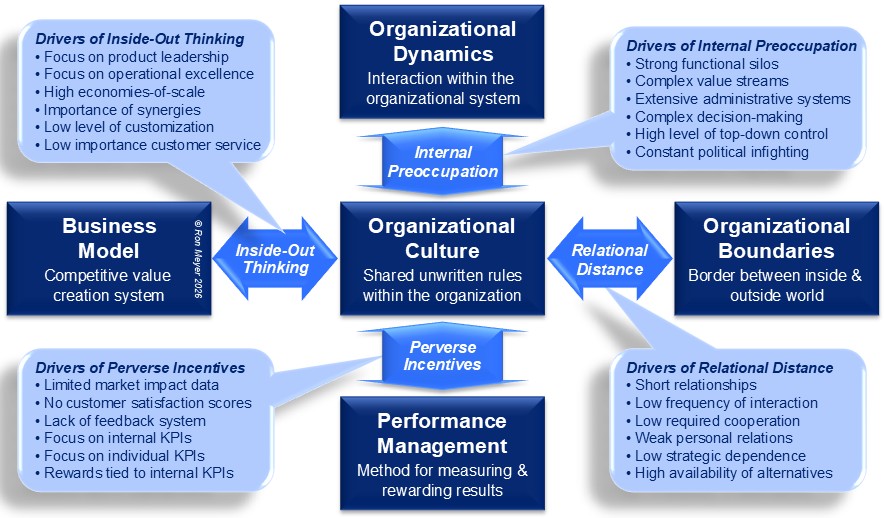
The five company-centric forces are the following:
1. Organizational Culture. At the center of the model is an inward-oriented culture, that values organizational, departmental or even individual views and interests above those of the customer. Like an ego-centric person, company-centric people believe their worldview is the correct one and they know what good looks like. Dealing with each other is also seen as more important than dealing with customers. Once this culture of self-involvement takes root, it becomes self-perpetuating and can be further strengthened by the other four forces.
2. Business Model. The type of business model chosen can influence how much outward-orientation people believe is necessary. Companies competing on personalization and customer service need to think outside-in, while competing on product leadership, operational excellence, economies-of-scale and capturing synergies push people to think inside-out and concentrate on internal processes. The more the inside-out thinkers capture attention and can claim success, the more a culture is nudged towards inward-orientation.
3. Organizational Boundaries. Companies often create strong organizational boundaries by keeping their distance from customers. They interact and cooperate infrequently, and avoid personal and long-term relationships, either because they don’t want to, or don’t have to. Keeping customers at arm’s length is generally easier where dependency on customers is low and there are plenty of alternatives. Yet, distance invariably leads to less understanding of, and interest in, customers, thereby reinforcing an inward-oriented culture.
4. Organizational Dynamics. Companies can also become intensely preoccupied with their own processes and procedures, which shows up in extensive meeting schedules and reporting systems. Strong silos are by nature inward-oriented, but if they need to coordinate because of complex value streams, procedures and meetings proliferate. Self-involvement is further strengthened by complicated decision-making, political games and top-down controls. When employees are busy with each other, they’re not busy with the customer.
5. Performance Management. Finally, companies often measure and reward the wrong type of results. Instead of tracking market impact data and customer satisfaction feedback, companies often use internal performance indicators, typically at the level of a department or individual, encouraging employees to shortsightedly focus on their own work. Where recognition and rewards are linked to these internal, instead of external, results, a perverse incentive is given to become even more inward-oriented and ignore customer satisfaction.
Key Insights
• Company-centricity is extensive inward-orientation. Organizations, like people, find it much easier to understand and be busy with themselves, instead of with others. This inward-orientation, as opposed to outward-orientation, comes in various shades of grey, with at its extreme a far-reaching form of self-involvement called company-centricity.
• Company-centricity is at its heart cultural. Company-centricity is a mindset common to people in an organization, leading to typical behaviors and ways of working. In other words, company-centricity is cultural – unwritten norms based on shared values and beliefs.
• Company-centricity is driven by five forces. A company-centric culture is self-perpetuating and can be reinforced by four other factors: A business model that emphasizes the importance of inside-out thinking, strict organizational boundaries that lead to relational distance, complex organizational dynamics that trigger internal preoccupation and a performance management approach that creates perverse incentives.
• Company-centricity grows over time, if unchecked. These five company-centric forces drive a vicious cycle, gradually decreasing awareness of, and interest in, customers.
• Company-centricity needs to be understood to be countered. The Five Company-Centric Forces model is an analytical framework for understanding the factors causing company-centricity, thereby suggesting places to start building more customer-centricity.
Five Company-Centric Forces is part 80 of a series of management models by prof. dr. Ron Meyer. Ron is managing director of the Center for Strategy & Leadership, where he publishes regularly.



:quality(75))
:quality(75))