


:quality(75))
:quality(75))
How can I build a learning organization? TIAS professor of Strategic Leadership Ron Meyer presents an insightful tool to kickstart your thinking: Competence Guilds.
Key Definitions
Learning is the process of acquiring new knowledge (information and insights), capabilities (routines and skills) and attitudes (values and mindset). Competence development is learning directed at making people more effective at achieving results in a particular area.
Learning can be done by individuals, but knowledge, capabilities and attitudes can also be built up in teams and organizations. Where organizations are adept at continuously learning, from their own experience and external sources, they are called learning organizations – they have learnt how to learn and can constantly upgrade and renew their competencies.
Conceptual Model
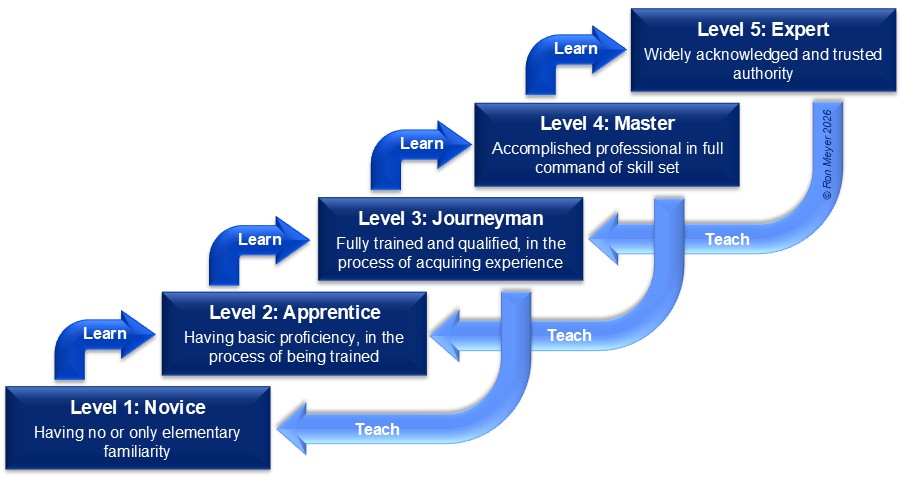
The Competence Guilds framework is a model for building a learning organization. It suggests dividing all organizational members into five levels of ability for each strategically important type of competence. Each individual can then progress through each level by learning (arrows on the left). The key to faster organizational learning is that people at a higher level of competence take the responsibility for teaching people at lower levels (arrows on the right), similar to how guilds used to function. Teaching is not made abstract and outsourced to external schools but kept practical and embraced as a crucial leadership task. The experts and masters in each competence area run their guild together and drive organizational learning. As competence levels don’t necessarily coincide with hierarchical levels, anyone can be involved in leading a guild and everyone can be involved in teaching somewhere.
Key Elements
The five competence levels and their roles are the following:
1. Level 1: Novice. As newcomers to a competence area, novices need to build up rudimentary familiarity with the topic. Much of this basic learning can be generic, making use of external written materials or training programs. However, some of the introductory teaching can be made more organization-specific and provided by journeymen under supervision of a master. By teaching, journeymen learn just as much as the novices.
2. Level 2: Apprentice. As trainees, apprentices are insufficiently skilled to operate entirely independently, so they are guided on-the-job by masters and journeymen. By watching their skilled colleagues in action, and receiving coaching by them, apprentices learn-by-doing in the practical context of the organization. This hands-on learning can be complemented by more formalized classroom training by the masters.
3. Level 3: Journeyman. As fully qualified professionals in a competence area, journeymen are capable of operating independently and typically become increasingly proficient the more they practice. Given their completed training, they are well-positioned to pass on this training to novices, gaining extra experience themselves by doing so. At the same time, they also still learn from the mentoring provided by masters and experts.
4. Level 4: Master. As accomplished professionals in their competence area, masters set and maintain the internal quality standards of the organization. Given their mastery, they are well-placed to train apprentices, both by example on the job and by formal means in class. Yet, at the same time, they keep learning themselves, from external experts and from other internal masters and experts, who share their insights and best practices.
5. Level 5: Expert. As authorities in their field, experts are widely cited and consulted by people inside and outside the organization. Given their acknowledged abilities, they lend external credibility to their organizations, while acting as internal role models for masters and journeymen. Practically, they mentor journeymen and spar with masters, which helps them to keep learning, and shows others that learning is never finished.
Key Insights
• Competence development is of strategic importance. In an ever-changing world, remaining relevant means constantly upgrading existing organizational competencies and developing new ones. This requires ongoing organizational learning.
• Competence development can be done at five levels. For each specific type of competence, five ability levels can be distinguished. Novices are literally new to the field, while apprentices have taken on the challenge of trying to master a competence. Journeymen have reached the threshold of being able to work competently on their own but still need to fine-tune their art to become true masters. The fifth level of expert is achieved when someone is externally recognized as an authority on the competence.
• Competence development shouldn’t be outsourced. Organizations can send individuals or even whole teams to external trainers for a one-off update, yet this seldom leads to a jump in competence and doesn’t help the organization to continuously develop its competences itself. Organizations need to organize their own organizational learning.
• Competence development can be driven by competence guilds. A powerful way of structuring organizational learning is to organize competence-specific guilds, in which the experts and masters take responsibility for driving competence development, by determining what needs to be upgraded in future, while mentoring and teaching others.
• Competence guilds need to be organized. As competence levels and management levels don’t necessarily coincide, competence guilds need to be organized as separate learning communities, with their own leaders, objectives, ways of working and budget.