




How can I improve cross-unit alignment in my organization? TIAS professor of Strategic Leadership Ron Meyer presents an insightful tool to kickstart your thinking: Alignment Bridge.
Key Definitions
An organizational structure is the way that an organization formally divides its value-adding activities, and the people who perform them, into a variety of smaller units. Depending on their size, organizations can be split up into divisions, businesses, regions, departments and teams. This structuring into separate units can be visualized in an org chart.
For organizations to work effectively, these units shouldn’t function as independent silos but require some level of cross-unit alignment – coordination between them to achieve joint goals. This need for alignment doesn’t show up in an org chart but can be captured in process maps, such as value stream diagrams and RACI matrices but both are limited in supporting alignment.
Conceptual Model
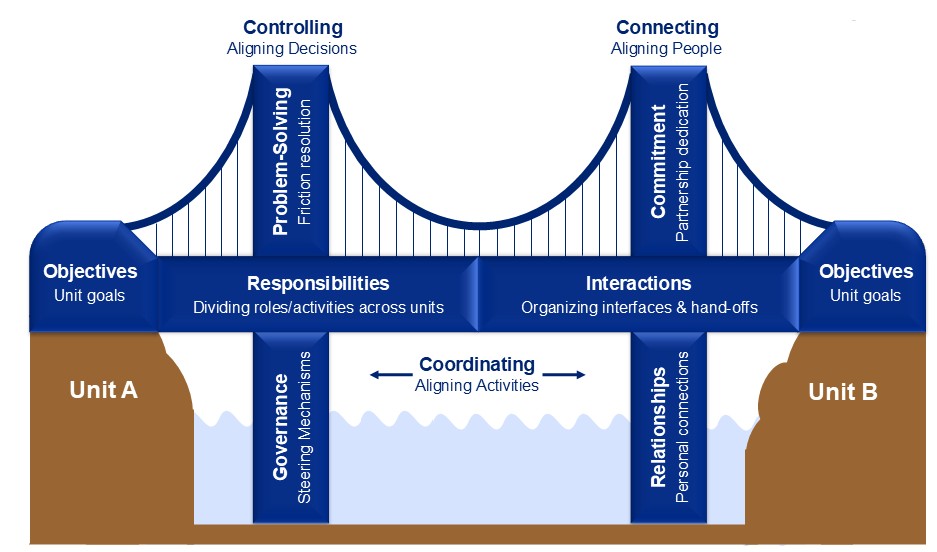
The Alignment Bridge model gives an overview of the key factors required to achieve alignment between two or more units. It suggests that both sides need to bridge the gap between them by first aligning their objectives and then their activities, to realize coordinated value-adding processes (also called value streams) or cross-unit synergies. To “hold up and support” these coordinated activities, both sides also need to align their decisions and their people. To build and maintain the bridge requires continuous effort from both units. This model can be used as a checklist for joint discussions on how to initiate and sustain valuable cross-unit alignment.
Key Elements
The seven factors contributing to effective cross-unit alignment are the following:
1. Objectives. Alignment should always start with determining why the units need to work together in the first place. Do they follow each other in a process, or does one provide services to the other, or can they achieve joint synergies? Both need to negotiate in which areas they want to cooperate, what they want to achieve and under which conditions.
2. Responsibilities. Once the shared objectives have been set, the two sides can determine who does what. They can “contract” which activities will be carried out by each side, ensuring that all bases are covered, while there is no unnecessary overlap. Part of the agreement includes clarifying mutual expectations regarding quality, timing and budget.
3. Interactions. With the activities divided, both parties also need to determine where the interfaces between the activities will be and where products, services or resources will be handed off to the other. The interfaces are moments of contact where coordination or joint activities can take place, while hand offs are the moments of transfer between parties.
4. Governance. Once the activities have been coordinated, both sides need to determine how related decisions will be made, implemented, reviewed and adjusted, as well as who will be involved in what manner. They must also agree on a joint set of rules and regulations, to control what type of behavior is allowed and expected.
5. Problem-solving. Yet, even with a well-designed governance set-up, there will always be unforeseen frictions that need to be resolved. Smaller issues can often be tackled by informal contacts on the work floor, but more challenging problems often require more structured problem-solving mechanisms such as trouble-shooting teams or taskforces.
6. Relationships. Still, alignment requires more than organizational systems and processes. Besides controls to align decisions, personal connections are needed to align people. Individuals need to have workable relationships with each other, built on an understanding of the other’s qualities and mindset. Interpersonal alignment hinges on mutual confidence.
7. Commitment. Just as good governance doesn’t prevent all problems, good relationships don’t prevent interpersonal frictions, misunderstandings and irritations. Therefore, both sides need to be dedicated to their partnership, willing to work on their relationship and resolve occasional issues, even if it would be easier to blame and shame the other party.
Key Insights
• Cross-unit alignment is essential but hard. Work is easily divided among people, but much less attention is paid to getting them to work together, especially across units, such as teams or departments. The usual approach is to let a higher level of management enforce cooperation, instead of making alignment the responsibility of the units themselves.
• Cross-unit alignment starts with aligning objectives. To get two or more units to voluntarily build a bridge over the gap between them, they must begin by clarifying where their interests coincide. This can be the basis of shared goals that motivate cooperation.
• Cross-unit alignment should focus on aligning activities. With shared goals, both sides need to determine who will take responsibility for which activity and how they will interact.
• Cross-unit alignment should be supported by aligning decisions and people. Yet, just aligning activities is not enough to ensure smooth coordination. The bridge needs two pillars to hold up and support the aligned activity flow. The first pillar is aligning decisions, by organizing good governance and effective problem-solving. The second pillar is aligning people by building strong relationships and stimulating commitment to the partnership.
• Cross-unit alignment should be contracted. Often, it is believed that a simple RACI matrix (Responsible, Accountable, Consulted and Informed) is good enough to achieve