


:quality(75))
What are the strategic resources available to my organization? TIAS professor of Strategic Leadership Ron Meyer presents an insightful tool to kickstart your thinking: Resource Base Dial.
Key Definitions
An organization’s resources are all the means at its disposal that can be used to carry out value-adding activities and create value propositions. Note that people are not resources, but the carriers of resources, such as knowledge, skills and relationships (just as a CD is not music, but a music carrier). Unfortunately, the term human resources is an enduring misnomer.
Following Barney (1991), we define strategic resources as those that meet the VRIO criteria: they are valuable (important for running the business), rare (not widely available to rivals), inimitable (difficult to copy or substitute) and organized (readily available to the business).
Conceptual Model
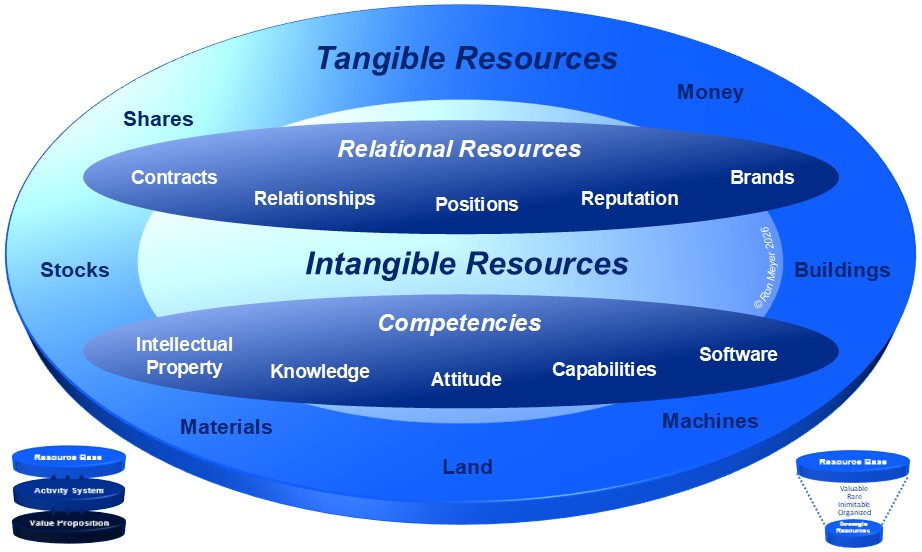
The Resource Base Dial is a framework for mapping all the resources available to (or needed by) an organization to run its business system (see model #32, Strategic Alignment Model). Importantly, this framework looks beyond the tangible resources on an organization’s balance sheet, to identify additional intangible resources – their competencies and relational resources. Once an inventory of all resources has taken place, this can be checked against the resources needed to run the business system, so deficiencies can be spotted (see insert at bottom left) and an analysis can be made of which resources qualify as strategic, so further resource-based strategy development can build on these (see insert at bottom right).
Key Elements
The two main categories of resources are the following:
1. Tangible Resources. This is all the stuff that organizations need to function, varying from office buildings to coffee machines, to the money to buy new coffee. Tangible resources tend to be things “you can drop on your foot”, but cryptocurrencies and data are also tangible, as they can be isolated, counted and traded. Sometimes tangible resources are strategic, such as a custom-made production robot or the building housing a hotel, but most tangible resources can be easily acquired or copied, making them non-strategic. As rule of thumb, bookkeepers count what strategically doesn’t count.
2. Intangible Resources. These are all the resources that can’t be seen, can’t be bought or sold but need to be gradually developed. They are embedded in the people and the organization in which they have grown, making them difficult to copy and almost impossible to transfer. There are two distinct categories of intangible resources:
a. Relational Resources. These are all means that are based on connections between individuals or organizations. Once relationships have been built up, they have the potential to be used to influence others to behave in a particular way. Even where people don’t know each other, but know of each other, that reputation can be leveraged to get things done. In the same way, positions in associations, boards and informal groups can be used to exert influence. Note that these intangibles can sometimes gradually become more tangible, such as relationships being formalized into contracts and reputations being linked to tangible brands. In this way, some football players’ contracts and the team’s brand can even make it onto the balance sheet.
b. Competencies. While relational resources are about influence, competencies are about ability – the potential to get things done. It is often said that to act effectively, people and/or organizations need to combine the right knowledge (insight/intelligence) with the right attitude (mindset/philosophy), so they can develop practical capabilities (skills/knowhow). These competencies are learnt and embedded over time, sometimes by separate individuals, but often by cooperating teams of people, often establishing systems and processes to ensure the learning sticks. Note that here too intangibles can gradually become more tangible, as ways-of-working are hardwired into procedures and software, while knowledge is captured in wikis or even as intellectual property.
Key Insights
The resource base is a key part of the business system. Every business system is a simple input-output function, with resources going in to run various activities, resulting in a value proposition coming out. To optimize this economic value creation system, an overview is needed of the required and available resources (see model at bottom left).
The resource base consists of tangible and intangible resources. Organizations need hordes of resources to function. These can be tangible (means that can be separated, counted and traded) or intangible (embedded in the organization and developed over time).
The resource base includes relational resources and competencies. Intangible resources can be divided into two subcategories: relational resources that give individuals or the organization influence, and competencies that give them the potential to perform.
The resource base can be the basis of strategy. The resource-based view of the firm suggests that sustainable competitive advantage can be derived from leveraging resources that are strategic - that are valuable, rare, inimitable and organized (VRIO). Therefore, identifying, improving and protecting these strategic resources is a crucial strategic action.
The resource base is a strategic stepchild. In practice, few organizations put emphasis on understanding their resource base and most fail to uncover their strategic resources.
The Resource Base Dial offers a simple starting point to identify all existing resources and then to zero in on the strategic resources that could be leveraged (see model bottom right).
Resource Base Dial is part 82 of a series of management models by prof. dr. Ron Meyer. Ron is managing director of the Center for Strategy & Leadership, where he publishes regularly.