


:quality(75))
:quality(75))
Which key roles should be played by the corporate center in my company? TIAS professor of Strategic Leadership Ron Meyer presents an insightful tool to kickstart your thinking: 7I Corporate Center Model
Key Definitions
In management jargon, a corporation is a company consisting of two or more business units. While each business unit has its own strategy and focuses on succeeding in its own market, to make economic sense a corporation needs to be more than just the sum of its business unit parts. An overarching corporate strategy is needed to ensure corporate value-added.
It is the task of the corporate center, the level above the business units, to drive this corporate value creation process. In carrying out this task, a number of corporate center roles can be played, each with their own activities, instruments and types of value-added.
Conceptual Model
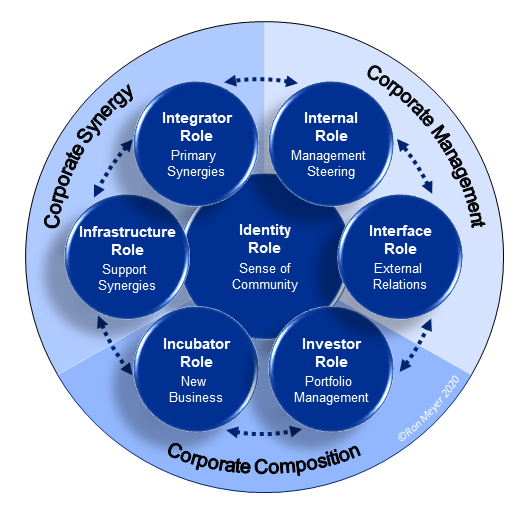
The 7I Corporate Center Model describes the seven possible roles with which the corporate center can add value to the company. Every corporate center needs to choose which roles they want to play, in what way and with which intensity. The roles fall into three general categories; corporate composition roles determining which businesses should be part of the corporate portfolio, corporate synergy roles stimulating cross-business linkages, and corporate management roles focused on steering the businesses towards optimal performance.
Key Elements
The seven possible roles of the corporate center are the following:
Investor Role. As investment portfolio manager, the corporate center can actively optimize the allocation of financial resources across existing business units, pumping funds into some, while withdrawing it from others. At the same time, it can consider opportunities for acquisition and potential divestment.
Incubator Role. As driver of new business development, the corporate center can nurture the founding of novel business activities outside the scope of the current business units, by supplying internal or external entrepreneurs with advice, knowledge, contacts, money and facilities. This support is particularly important for innovative business ideas.
Infrastructure Role. As provider of shared services, the corporate center can offer high quality support activities in such fields as IT, HR, Finance, Legal, SHE (safety, health & environment) and Facility Management. This support infrastructure can unburden business units, while creating synergy by bundling expertise and achieving economies of scale.
Integrator Role. As architect of competitive advantage, the corporate center can integrate the business models of two or more business units, leveraging strengths in such areas as R&D, operations, marketing and sales. By facilitating synergy across such primary activities, the strategic position of the business units can be greatly improved.
Internal Role. As line manager for the business unit heads, the corporate center can steer their behavior by setting strategic guidelines, challenging their strategic plans, checking on performance, assisting in solving problems and giving feedback. The recruitment, promotion, retention and rewarding of business unit heads is also part of this role.
Interface Role. As external stakeholder manager, the corporate center can be a more authoritative and active counterpart for such actors as shareholders, investors, banks, governments, regulators, unions, industry associations, NGOs and media organizations. Lobbying and corporate communications are also part of this role.
Identity Role. As heart of the organization, the corporate center can foster a sense of community within the company, encouraging the business units to work together as a team towards a common interest, sharing and helping each other along the way. Building and maintaining this joint identity can support being effective in all of the previous six roles.