


:quality(75))
:quality(75))
Which elements make up who I am, and can I develop these? TIAS professor of Strategic Leadership Ron Meyer presents an insightful tool to kickstart your thinking: Personal System Map.
Key definitions
Each person is a complex system of interconnected parts, that defies a simple division into independent building blocks. Still, it can be analytically useful to unravel people into a few key elements, to understand which parts are more susceptible to development than others.
For centuries, philosophers, scientists and amateur psychologists have debated whether people are largely shaped by nature (genes) or nurture (learning), and to what extent their characteristics are stable or can change over time. However, it is safe to say that at least some aspects of a personal system have been learnt and can be developed further moving forward.
Conceptual Model
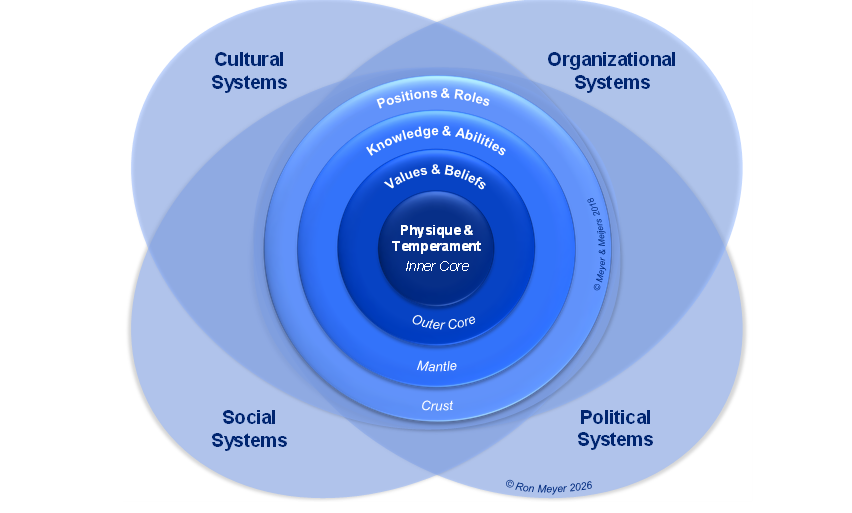
The Personal System Map is an analytical framework (building on Meyer & Meijers, 2018) for understanding which elements make up who a person is, and which will be easier to develop over time. Using the metaphor of a planet, the model suggests that each person consists of four layers, with each deeper one being less adaptable. At the same time, each person is embedded in four external systems that, as four linked types of atmospheres, influence the planet from the outside-in. The message is that people are partially shaped by the systems they operate in and that the most effective way to develop is to also change from the outside-in – changing positions and roles first and then working inwards.
Key Elements
The four layers making up each individual are the following:
Physique & Temperament. Each person’s most stable aspect is their physical body (their hardware) and their fundamental personality traits (their operating system). They might gain some weight, but they won’t get taller, while their “big five personality traits” can shift a bit over the years, but not change radically. Both are strongly influenced by genes.
Values & Beliefs. On this operating system people run a few basic programs that define what to them is of importance (their values) and what is obviously true (their beliefs). These principles form the cognitive filter through which they perceive the world. While rooted in their temperament, both were shaped, and can still be influenced, by external factors.
Knowledge & Abilities. On top of the basic programs, they collect a lot of information and insights, both tacit and articulated (their knowledge), while also developing app-like skills and routines that allow them to act (their abilities). These are easier to learn, influenced by external factors, but need to fit within the frame of a person’s underlying values and beliefs.
Positions & Roles. Using one’s knowledge and abilities, a person can fulfill formal positions in organizations and play informal roles in a variety of external systems. This is the easiest aspect of a person to change, as one can switch jobs (“I was a manager, now I’m a professor”) and/or pick up new roles (“I’m now a stepfather”).
Positions and roles are part of a personal system (you are your position/role), but at the same time they are also part of one of these external systems:
I. Cultural Systems. A person can belong to various groups who share unwritten behavioral norms, based on common values and beliefs, and expressed in shared customs, symbols and stories. You can be part of a national, professional or even pop culture (“I’m a Swiftie”).
II. Organizational Systems. A person can belong to various organizations, which are people structurally cooperating to achieve joint goals. You can work at a business or non-profit organization, but you can also be a member of a sports club or church (“I’m a Catholic”).
III. Political Systems. A person can also belong to a web of stakeholders, each with their own power and interests, who interact with each other to decide on important issues. You can participate in governmental politics, but also in networks and associations (“I’m a lobbyist”).
IV. Social Systems. A person can also belong to various social groups, that share a sense of relatedness, closeness, attachment and loyalty, such as families, clans, tribes, fraternities and communities (“I’m a Meyer”).
Key insights
People consist of four levels. Each person can be understood as made up of four levels: an inner core of physique and temperament (“I’m tall and extrovert”), an outer core of values and beliefs (“I’m liberal and democratic”), a mantel of knowledge and abilities (“I’m anglophone and golf”) and a crust of positions and roles (“I’m a teacher and husband”).
People are embedded in four external systems. Each person’s positions and roles are part of four overlapping external types of systems: cultural, organizational, political and social systems. People can be embedded in hundreds of different systems.
People are shaped through nature and nurture. From birth, people develop from the inside-out based on their physique and temperament (nature) and simultaneously from the outside-in, based on the positions and roles that they take (nurture). The result is a mix.
People find it hard to change inside-out. The traditional approach of teaching people new knowledge and abilities without adapting their positions and roles rarely leads to lasting change. People stuck in existing systems quickly revert to old, ingrained behavior.
People find it easier to change outside-in. By changing systems, shifting to new positions or roles, people acquire new specific knowledge and abilities (learning-by-doing), which can then even impact their values and beliefs. As the old saying goes: “It is easier to act yourself into a new way of thinking, than to think yourself into a new way of acting”.
Personal System Map is part 81 of a series of management models by prof. dr. Ron Meyer. Ron is managing director of the Center for Strategy & Leadership, where he publishes regularly.