


:quality(75))
:quality(75))
How can I give colleagues quick insight into how to work with me? TIAS professor of Strategic Leadership Ron Meyer presents an insightful tool to kickstart your thinking: Personal Quick Guide.
Key Definitions
A résumé, or curriculum vitae, is a document giving an overview of a person’s past education, jobs, and accomplishments, as well as their qualifications and skills. It is used when applying for a job or new position and focuses on factual information about the person to date.
A résumé is not an introduction to explain how it is to work with someone. Limited information is provided about a person’s strengths and weaknesses, and nothing is said about their preferred way of working. Generally, this insight needs to be discovered along the way.
Conceptual Model
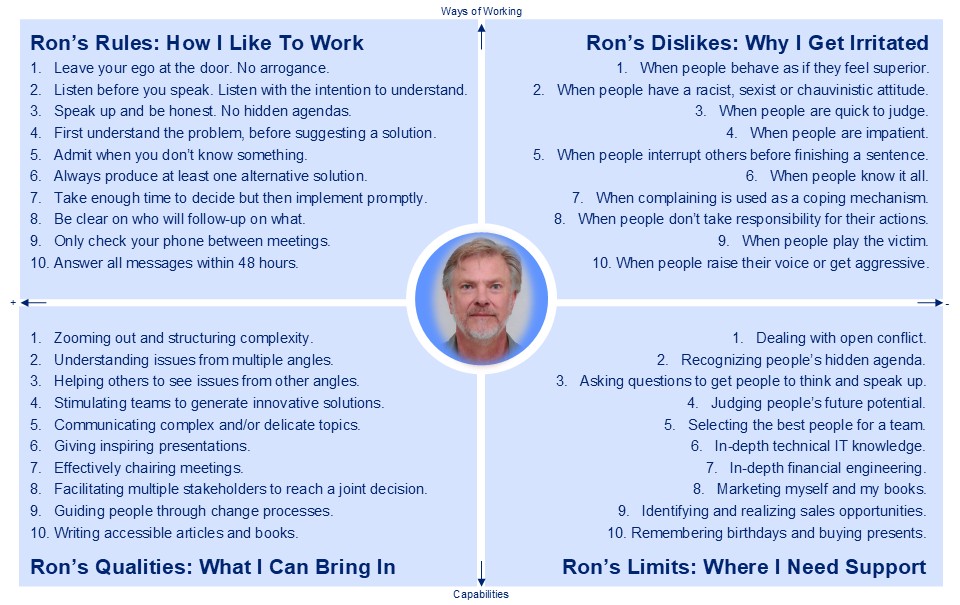
The Personal Quick Guide is a simple template for providing new colleagues or partners with some first insights into how to work with you. It gives a quick introduction to your operational profile, by outlining your preferred ways of working (the top two boxes) and the capabilities you can bring to the table (the bottom two). Below is an example of the types of insights that can be shared with others, using myself as tangible illustration. The more specific your points, the faster others will start to understand how to engage with you. Note that identifying these 40 points not only helps others but also leads to increased self-insight as valuable spin-off.
Key Elements
The four categories giving quick insight into how to work with you are the following:
1. Your Rules: How You Like To Work. If you could set rules about how people around you should behave, what would these be? What do you believe makes working together effective and efficient, but also what gives you energy and creates flow? Some things will be obvious to everybody (“speak up”) but you want to mention the preferences you have that are not universal (“give at least one alternative”) or that people find difficult to adhere to (“listen before you speak”). Know your unwritten norms and make them written rules.
2. Your Dislikes: Why You Get Irritated. What are your buttons that other people shouldn’t push? In some cases, these irritants will make you openly angry, which some socially-aware people will understand, but will baffle the less gifted, so it’s better to explain your quirks upfront. In other cases, you might not get angry, because of character or culture, but people’s behavior might still sap your energy and/or disrupt your workflow. Therefore, you need to share your “user’s manual” and help them to avoid short-circuiting you.
3. Your Qualities: What You Can Bring In. What are your distinctive capabilities that can be useful to others? On résumés people will often mention personal characteristics (“positive”, “team player”), but not specific abilities that can be contributed to the team. Most people find it difficult to recognize their own distinguishing qualities, because these skills are normal to them – as they are good at them, they find them easy to use. Therefore, you will often need to ask others to tell you what you are good at.
4. Your Limits: Where You Need Support. What are the areas where you need other people to help you out? No one is good at, or has energy for, everything. Yet it can be difficult to accept your own limitations and even more difficult to admit to the people around you that you need their support on specific topics. Still, recognizing your weaker points can be liberating to yourself, as you don’t have to keep up appearances, while showing others that you’re self-aware and only human, which will invite them to assist you where necessary.
Key Insights
• Your Personal Quick Guide is your user’s manual. Don’t you hate buying a complicated apparatus without a user’s manual and then spending months trying to figure out how it works? The Personal Quick Guide is such an “instruction book on one page”, giving the reader rapid insight into your do’s and don’ts, to speed up their orientation.
• Your Personal Quick Guide is complementary to your résumé. Just as a sales brochure and a user’s manual are different yet complementary, so too are your résumé and your Personal Quick Guide. Both help to get to know you, but the first is for the job application phase and the latter for the onboarding phase.
• Your Personal Quick Guide outlines your preferred ways of working. The top half of the Personal Quick Guide gives insight into the process-side of you – how you prefer to work, particularly in interaction with others. Sticking to your rules will facilitate your flow, while triggering your irritants will upset your flow. By stating these, you’re not demanding that people work the way you want but making clear how you will perform at your best.
• Your Personal Quick Guide outlines your capabilities. The bottom half of the Personal Quick Guide gives insight into the input-side of you – which capabilities you can or can’t bring to the job. Your qualities are your distinctive strengths, while your limitations are your relative weaknesses. By stating these you make it easier for others to know when to call on you and where they can pitch in to help you out.
• Your Personal Quick Guide also stimulates your self-insight. While the Personal Quick Guide is intended to give others insight into you, drawing it up often also gives you insight into yourself. To explain what makes you different, you need to reflect on yourself and determine where you’re not normal, that is, where you deviate from the norm. Coming up with four or five points is easy, but getting to ten really challenges your self-reflection.