


:quality(75))
:quality(75))
How can I give people effective feedback? TIAS professor of Strategic Leadership Ron Meyer presents an insightful tool to kickstart your thinking: Feedback Flavors Framework.
Key Definitions
In cybernetics (the study of control systems), feedforward is the initial assignment given to a system or person to direct its behavior, while feedback is the information looped back to that system/person with the goal of correcting or confirming its course of action. In other words, the purpose of feedback is to steer the other in the intended direction.
Unfortunately, in common usage, “feedback” has come to mean any type of comment that people make to someone else. “Can I give you some feedback?” is usually followed by an assessment, complaint, frustration and/or verdict. However, expressing a judgment without the intention of steering the other’s behavior isn’t feedback, but merely stating one’s opinion.
Conceptual Model
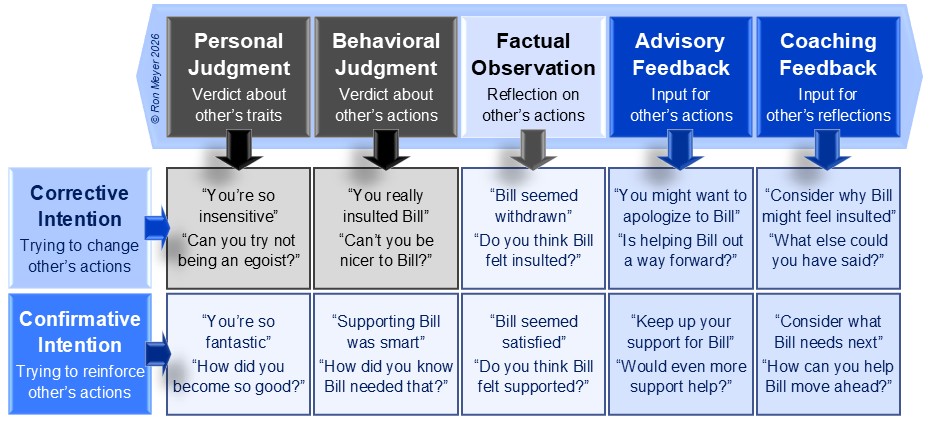
The Feedback Flavors Framework is a model outlining ten categories of responses that people can give to the behavior of others, of which four “flavors” qualify as highly effective feedback and four as moderately impactful. The main purpose of the model is to help distinguish between judgment and effective feedback. A response is a judgment if it is intended to convey the sender’s evaluation. It is only effective feedback if the response is tailored to influence the receiver’s behavior. Stated simply, judgment is “what I would like to say”, while feedback is “what the other needs to hear”. So, giving effective feedback requires the sender to move beyond merely expressing an opinion, to consider how to get the receiver to move in a particular direction. The framework then suggests four highly effective feedback flavors (in darker blue) and four moderately effective ones (in lighter blue). Two are usually ineffective.
Key Elements
The two opposite reasons for wanting to give feedback (on the vertical axis) are:
1. Corrective Intention. Feedback is often used to correct course and get the receiver back on the right track. It focuses on what is missing or wrong and is directed at closing the gap.
2. Confirmative Intention. Feedback can also be used to confirm the course and encourage the receiver to stay on track. It acknowledges what is going well and can be built on.
The five main categories of responses (along the horizontal axis) are the following:
1. Personal Judgment. Feedback can be directed at the personality of the receiver, which is nothing short of a verdict about their character. When positive, such feedback can help the receiver to feel appreciated, but if the feedback is critical, the receiver will likely feel personally rejected or even attacked, which rarely gets them to adapt their behavior.
2. Behavioral Judgment. Instead of judging the person, feedback can be focused on judging their actions. When positive, such feedback can help the receiver to feel recognized, but if the feedback is critical, the receiver will likely take it as a complaint or a difference of opinion, which typically leads to a defensive reaction, not necessarily adapted behavior.
3. Factual Observation. A more neutral form of feedback is where someone shares what they objectively see. This can make receivers more aware of the situation, nudging them to adapt or continue their behavior. But it can also reveal that both sides have a different perception of the facts, which can be a good start to even more effective forms of feedback.
4. Advisory Feedback. Instead of immediately expressing their judgment, feedback givers can transform their assessment into forward-looking suggestions. Such feedback can be useful advice on how to improve or further build on the receiver’s behavior. Key for achieving acceptance is that receivers feel they are being helped, not berated.
5. Coaching Feedback. Often, even more helpful than getting advice is being coached to come up with successful next steps yourself. This coaching can be in the form of questions or statements, intended to trigger a line of reasoning in receivers, so they formulate their own improvements or find their own ways to build on the current strengths.
Key Insights
• Effective feedback is receiver-oriented. We all judge others but voicing that opinion is not feedback. Sharing your views, or getting things off your chest, is not feedback. Feedback is the act of looping a signal back at a receiver with the intention of influencing their behavior. Feedback is only effective if it triggers a reaction. As with communication, it’s only effective if the message is packaged in a way that receivers will understand.
• Effective feedback avoids defensive mechanisms. No one likes being judged, even when feedback is called “a gift”. Judgmental comments feel like an attack, even when they’re sugar-coated, and provoke a defensive response. Therefore, effective feedback avoids judgment but instead is helpful – it doesn’t condemn but is constructive. It isn’t about pointing out what is wrong but helping to find out how things could be made better.
• Effective feedback can be corrective or confirmative. Effective feedback givers want to steer the behavior of feedback receivers (see Meyer’s Management Models #55, Duty of Care Model). This steering can be directed at getting receivers back on course (corrective feedback) or getting them to continue on course (confirmative feedback).
• Effective feedback comes in eight flavors. Of the ten categories of feedback, two are hardly ever effective (in gray), because of their critical judgmental nature. Four types of feedback can have a moderately effective impact (in light blue), while four others (in darker blue) can be much more impactful, because they use helpful advice or coaching as means.
• Effective feedback requires effort from the giver. Blurting out your opinion is easy. Calling your complaints “feedback” so the other is forced to listen is lazy. Effective feedback is hard, because it forces givers to think hard about how to trigger change in the receiver.